I’ve been thinking about hope a lot lately. Confronted with horrific world events as well as sickness, death, and the evils of life nipping at my own back door, the question of who one hopes in, and how that hope manifests itself into these “rubber meets the road” situations often causes me pause. In my own journey the Bible has always been a foundational pathway my finite mind has wandered to seek to understand this infinite God, incarnated in the Son of Man, and revealed through these ancient texts. Early in this journey I stumbled on Psalm 27:13 which the NASB translates, “I would have despaired unless I had believed that I would see the goodness of the LORD in the land of the living.” The truth of my own experience is that I would have despaired of life had I not SEEN this goodness. Thankfully, this goodness was manifested through people, things, and personal experiences that I have no other explanations for – though I desperately sought them. The story of how I fell in love with this Triune God is not one of sweet nothings whispered in the stillness of cool summer breezes. But surrender I did, and the journey has led me through various places of rest and work, degrees of darkness and light, stillness and storms. Even in the absence of seeing God working in the land of the living, I always carried Ebenezer stones in my own heart – undeniable markers, indicating the evidences of how God has worked in the landscape of my story.
Yet what happens when we are confronted with unanswered prayers, longings unfulfilled, natural disasters, or the depravity of man? What do you place your trust in when you can’t see Him? What do you hope in when evidence is lacking? When the path seems obscure, what light do you reach for in order to illuminate the darkness? I believe that in these moments our true theology is revealed.
Psalm 107 ends with this verse, “Whoever is wise, let him attend to these things; let them consider the steadfast love of the Lord” (v. 43). What are “these things”? The Psalmists here begins with an exhortation for the redeemed to proclaim the goodness of the Lord (1-3):
Oh give thanks to the Lord, for he is good,
for his steadfast love endures forever!
Let the redeemed of the Lord say so,
whom he has redeemed from trouble
and gathered in from the lands,
from the east and from the west,
from the north and from the south.
Who are those redeemed ones? What were they redeemed from? Hypothetical reader, I’m so glad you asked. The Psalmist describes several scenarios: wanderers in the desert thirsty and hungry; rebellious captives afflicted and bound; foolish sinners choosing paths leading to death; merchants pursuing wealth in turbulent climates. All of these face their own troubles, and yet the Lord is able to provide and deliver. This God can turn rivers to dry barren deserts, and deserts into bodies of water. He is one who is able to establish cities for protection and peaceful dwellings and brings forth nourishment from the ground. He is able to bring down the high and mighty, and raise the low to secure positions.
The question remains. What to do when one doesn’t see the goodness of the Lord in the land of the living? What does one do when there isn’t even a cool mist in the desert?
I believe this is where it might be good to consider faith as a spiritual discipline that can be cultivated and tended. In the same way that Bible intake renews the mind, prayer and meditation focuses affections, submission establishes relational order, giving allows an outflow for what has been received …. perhaps faith renews hope and establishes trust.
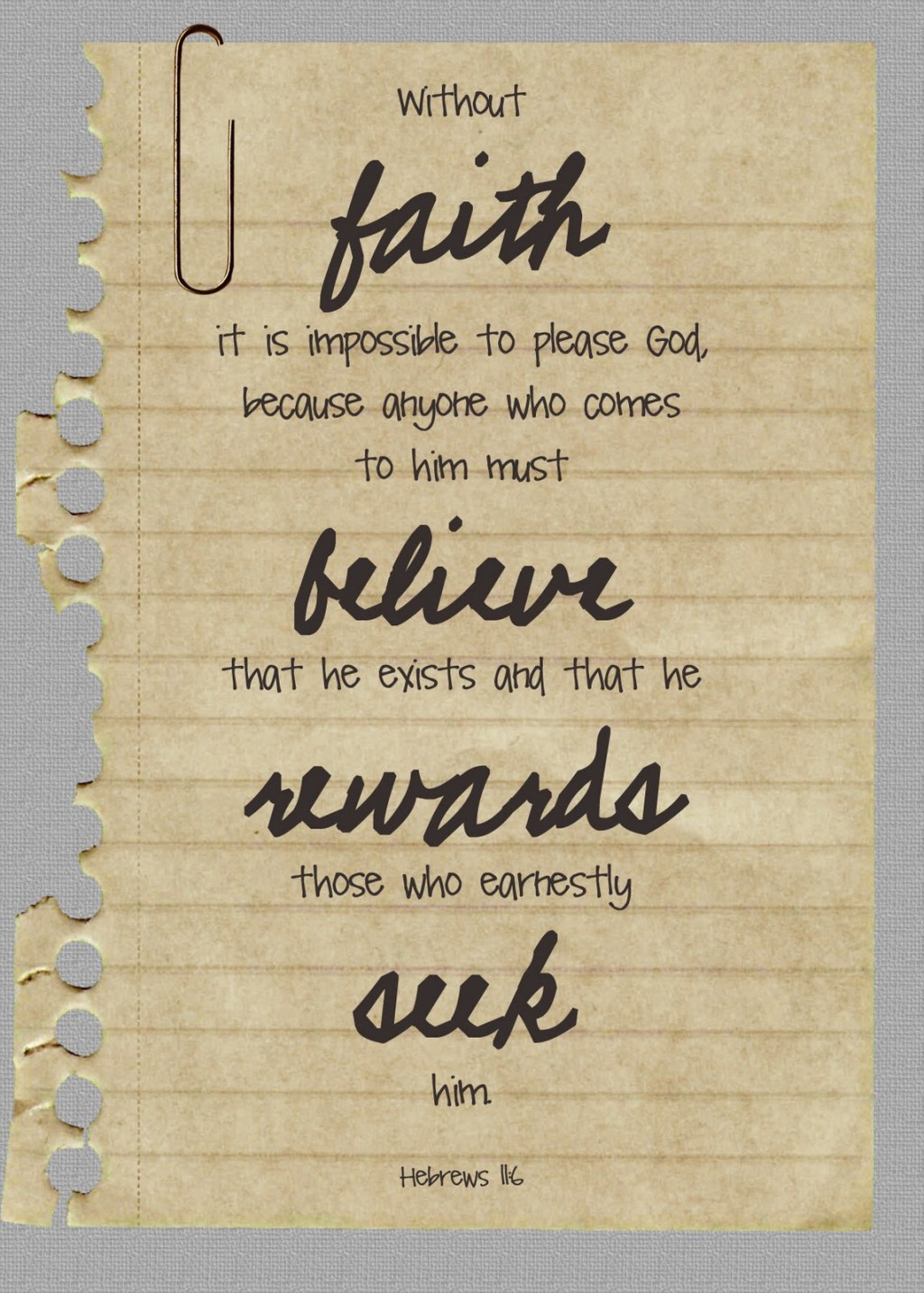
I don’t think it would be an understatement to say that faith is essential in one’s relationship with God. Hebrews 11:6, “And without faith it is impossible to please him, for whoever would draw near to God must believe that he exists and that he rewards those who seek him.” A few verses before this the author wrote, “Now faith is the assurance of things hoped for, the conviction of things not seen” (Hebrews 11:1). It’s refreshing to read the list of saints referred to as faithful in Scripture. None were perfect. Most never saw the complete fulfillment of God’s promises in the land of the living. Yet these faithful allowed their entire life’s course to be impacted by this God. And yet, it’s not enough to just believe or even to believe and obey.
One must believe that “he rewards those who seek him.” What we believe about God is perhaps the most important point of theology we can wrestle with. Is He good? Is He a drill sergeant? Is He demanding? Can He ever be satisfied? Is He holy? Is He good? Is He love? What, for you, defines who God is? The answer to that question, will reveal how you handle the “rubber meeting the road”.
Perhaps we might learn to say, “Before I was afflicted I went astray, but now I keep your word. You are good and do good; teach me your statues … It is good for me that I was afflicted, that I might learn your statues” (Psalm 119:67, 68, 71)). Perhaps these fiery trials will bring forth something more precious than refined gold. Can “bad” things lead to revealing God’s goodness? Yes. In God’s economy death can bring life, and pain can yield joy.
Psalm 27 ends with this verse, “Wait for the Lord; be strong, and let your heart take courage; wait for the Lord!” (vs 14). Oh that we would not grow weary (Gal 6:9) or shrink back (Heb 10:39) … but press on to know the Lord (Hos 6:3, Phil. 3:14), and experience Him as a good, good Father in the land of the living, and beyond. May we have unfailing faith.

 Anja Staten